Guide 04 · Operational Boundaries

Where Power Meets Site Operations

Temporary electricity does not operate in isolation. It intersects daily with stage rigging, catering logistics, fuel containment, municipal noise curfews, and formal licensing sign-off.

The Principle of Clear Demarcation

In a large festival employing dozens of specialist subcontractors, ambiguity at the electrical handover socket creates both operational friction and safety exposure. Standards such as BS 7909 emphasize naming a Senior Person Responsible (SPR) for the temporary electrical system and publishing a clear demarcation schedule before build begins.

Demarcation defines the exact physical outlet where the festival power contractor's scope ends and an incoming vendor's scope begins. For a major concert stage, the site power contractor typically delivers tested, protected supply to designated backstage distribution terminals for audio, lighting, video, and stage automation. From those points onward, touring production electricians connect their own inspected dimming racks, amplifier racks, and motor hoists. Neither team modifies equipment on the opposite side of the handover boundary without joint sign-off.

Interface 01

Stage & Touring Production

Requires isolated clean audio earths, agreed connector formats, pre-show voltage and phase-rotation verification by qualified technicians, and strict adherence to submitted rider schedules.

Interface 02

Concessions & Hospitality

Vendors arrive with varied appliances ranging from espresso machines to refrigerated trailers. Pre-connection visual checks, valid portable appliance inspection records, and bans on unrated domestic multi-way adaptors protect shared feeders.

Interface 03

Site Operations & Civil Works

Fence crews, marquee riggers, and water-pipe installers must work from a shared underground and surface utility map so stakes, ballast blocks, and vehicle routes never pinch or puncture live feeders.

Environmental & Municipal Boundaries

Noise, Fuel Containment, and Land Stewardship

Power compounds must coexist with neighbouring residents, wildlife zones, and heritage parklands. At waterfront and parkland festivals such as Ruisrock on Ruissalo island in Turku or Øyafestivalen in central Oslo, acoustic footprints and ground protection shape electrical layouts as heavily as load curves do.

Even super-silenced generator canopies emit low-frequency mechanical hum that travels across water or quiet residential streets after show curfew. Positioning compounds behind natural earth berms or acoustic hoarding, orienting exhaust outlets away from campsites, and transitioning to silent battery storage overnight mitigates community noise complaints.

Fuel storage introduces a parallel environmental boundary. Whether using low-sulphur diesel or renewable HVO, temporary tanks require double-bunded secondary containment, drip trays at refuelling couplings, spill-response kits, and clear separation from storm drains and waterways. Refuelling tankers follow restricted off-peak site access windows to stay clear of pedestrian crowds.

Interface Domain Primary Owner Shared Dependency
Municipal Grid Tie Local DSO & Licensed Contractor Early permitting, meter sealing, and restoration contact protocol.
Backstage Handover Site Power Team & Stage Production Verified connector schedule and sign-off prior to rigging power-up.
Fuel & Containment Fuel Logistics & Site Environmental Lead Bunded storage, spill kits, and curfew-safe tanker routing.
Commissioning Sign-Off Appointed Electrical Competent Person Inspection records required by licensing authorities before gates open.
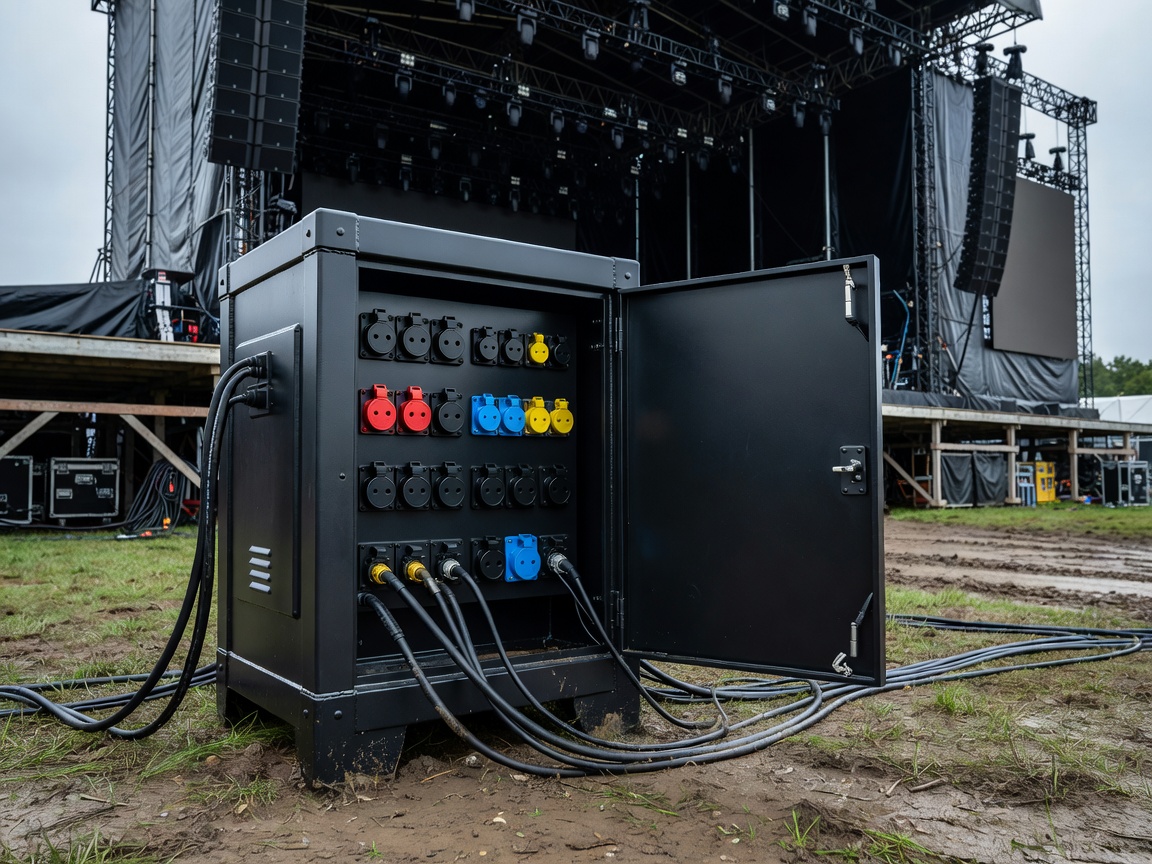
Organized backstage temporary power distribution enclosure showing clear circuit labelling at the vendor handover interface
Clear circuit labelling and locked distribution enclosures keep handover points legible during fast festival changeovers.

Commissioning, Sign-Off, and De-Rig Discipline

A festival electrical system is not ready for public opening simply because lights turn on. Before audiences enter, qualified electrical personnel complete structured visual inspections, dead testing, and live verification across every distribution tier, issuing formal completion certificates required by local licensing officers, insurers, and national electrical safety agencies such as Tukes in Finland.

Equally critical—yet frequently rushed—is the de-rigging sequence after the final encore. Site lighting, emergency egress paths, and welfare services must remain live while crowds depart and overnight security clears the arena. Only after the site is closed to the public do electrical teams execute a staged isolation plan, shutting down production feeders in reverse order so contractors never dismantle structures alongside unverified live cables.