Guide 03 · Resilience & Monitoring

Planning for Interrupted Supply

Continuity in festival power is not about guaranteeing zero faults; it is about structuring redundancy, isolation, and emergency autonomy so that a localized disruption never escalates into a crowd-safety crisis.

Separating Life Safety from Show Production

When a headline stage goes dark unexpectedly, the immediate hazard is rarely the pause in music—it is crowd confusion in an unlit arena without intelligible voice direction. Consequently, international event safety guidance such as the UK's Event Safety Guide (Purple Guide), BS 7909, and emergency lighting standard EN 1838 treat life-safety systems as a distinct electrical class.

Emergency exit signage, crowd-barrier illumination, site control rooms, medical tents, and emergency public-address voice alarms must remain energized even if the main stage entertainment supply trips or is intentionally shut down. In practice, this separation is achieved through independent supply paths, dedicated uninterruptible power supplies (UPS), or self-contained luminaire batteries inspected before public gates open. No show-control dimmer or trader circuit should ever share a protective device with emergency egress illumination.

Once life safety is structurally decoupled, production teams can make proportionate, budget-conscious decisions about how much redundancy entertainment and commercial zones truly require.
Redundancy Models

Synchronised Sets, Hybrids, and Changeover Logic

High-profile stages commonly employ N+1 redundancy through synchronised generator sets operating in parallel. Two or more generating units share a common busbar via an automated synchronising controller conforming to ISO 8528 governance. If one engine experiences a mechanical fault, fuel filter blockage, or cooling alarm, the remaining unit carries the load instantaneously while engineers isolate and service the faulted machine without interrupting the performance.

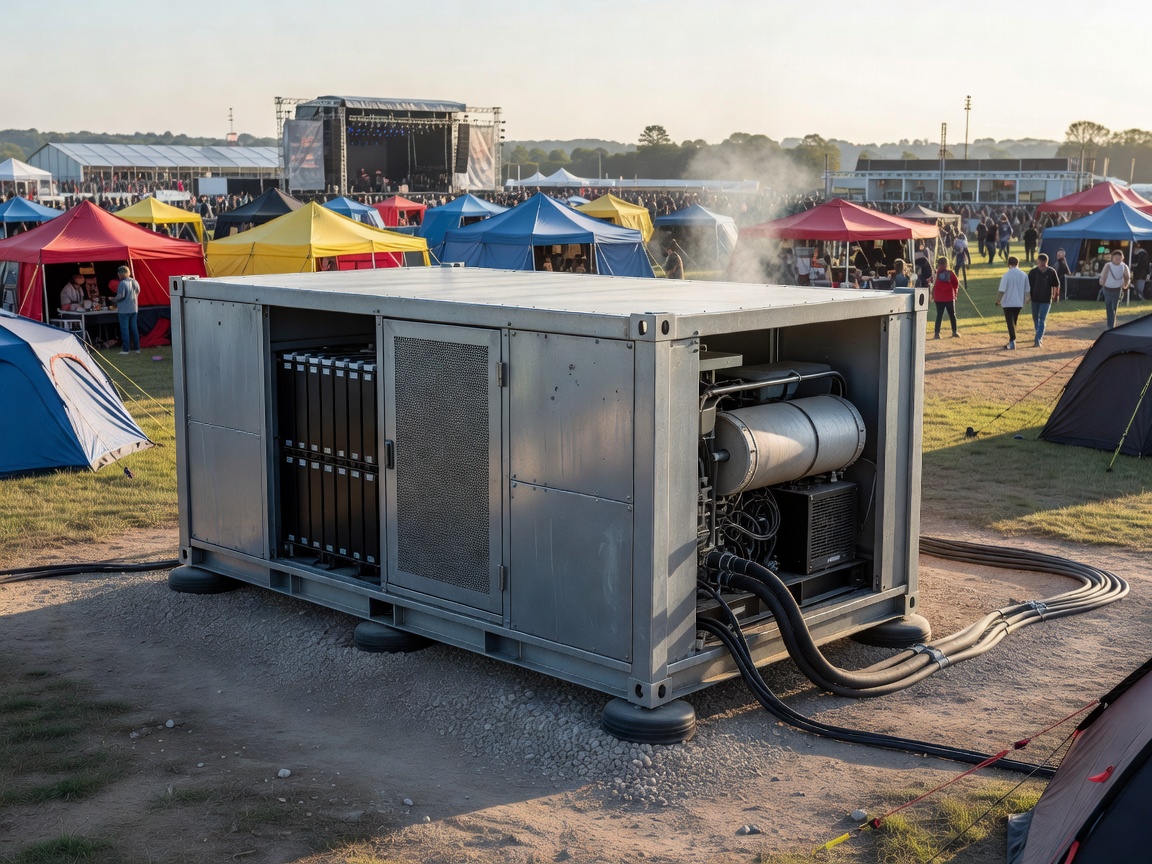
Where festivals connect to municipal electricity networks—a growing standard across Nordic urban events—continuity planning shifts toward grid-loss contingencies. A municipal feeder is generally cleaner and quieter than mobile engines, yet upstream street-network outages remain outside the festival's direct control. Strategic sites pair grid points with containerized Battery Energy Storage Systems (BESS) or standby automatic-mains-failure (AMF) sets for critical zones.

Beyond failover, hybrid BESS units elevate continuity during normal hours by smoothing sudden load steps, maintaining steady frequency during rapid stage lighting shifts, and running silently overnight so fuel tankers need fewer visits across crowded camp roads.

Source Unit A Source Unit B SYNC BUS N+1 Protection Stage Loads Independent UPS / BESS Egress Lighting, PA & Medical

Structural separation ensures that even a total fault on the entertainment synchronised bus leaves emergency illumination and evacuation audio active.

Resilience Scenario Disclosures

How Faults Are Contained in Practice

Well-prepared production teams rehearse response protocols before doors open. Inspect four common disruption scenarios and the conceptual safeguards that prevent escalation.

Scenario 1: Heavy rain causes an earth-leakage trip in a food village

Containment Mechanism: Properly coordinated residual-current devices isolate only the affected trader sub-circuit. Raised weather-rated enclosures (EN 60529) protect adjacent cabinets. Site electricians inspect moisture ingress and faulty trader cords before re-energizing; non-electricians never repeatedly reset tripped breakers.

Scenario 2: One generator in a main-stage twin-set trips mid-headline set

Containment Mechanism: In a synchronised N+1 pair, the healthy unit absorbs the active stage load seamlessly while telemetry alerts the compound duty technician. Production management may temporarily defer non-essential visual effects until standby redundancy is restored.

Scenario 3: Road congestion delays a scheduled HVO fuel delivery

Containment Mechanism: Continuity depends on logistics as much as switchgear. Double-bunded external auxiliary tanks, minimum reserve thresholds monitored via remote level sensors, and hybrid battery night-cycling extend autonomy well beyond normal delivery intervals.

Scenario 4: Upstream municipal outage hits a grid-connected urban festival

Containment Mechanism: Independent battery-backed emergency lighting and voice-evacuation systems hold crowd visibility immediately. Control rooms liaise with the local distribution system operator (DSO) to confirm restoration windows while automatic failover supports medical, ticketing, and safety command posts.

Monitoring Without Illusion

Modern temporary power compounds increasingly deploy remote telemetry portals tracking phase balance, fuel reserves, battery state of charge, and breaker status. However, software dashboards only strengthen continuity when paired with clear human escalation paths: a qualified duty electrician stationed near major compounds, radio channels that remain separate from general stage chatter, and documented isolation maps inside event control.

Equally vital is disciplined post-event review. Logging every nuisance trip, load spike, and changeover event builds institutional memory across festival seasons, turning resilience from an expensive insurance policy into a lean, verifiable operating practice.

Hybrid temporary battery energy storage unit paired with a silenced standby generator in a festival compound
Telemetry and standby battery storage work together when backed by trained on-site technicians and clear escalation procedures.