Guide 01 · Demand Architecture

Reading the Festival's Power Needs

Electrical planning for a major music festival starts long before the first cable truck arrives on site. Understanding how connected equipment translates into real-time demand is the foundation of right-sized, dependable temporary power.

Connected Load Versus Actual Demand

When production managers collect technical riders from headline artists, staging vendors, food stalls, and broadcast compounds, every department submits a list of requested electrical connections. Adding those nameplate figures together yields the total connected load. In practice, however, an outdoor festival almost never draws its full connected load at a single instant. Coffee machines cycle thermostatically, stage lighting rigs rarely run every fixture at full white output simultaneously, and audio amplifiers follow the dynamic crest factor of live music rather than a steady continuous wave.

Electrical planners distinguish between connected load and maximum anticipated demand by applying diversity—the recognition that different zones peak at different hours and duty cycles. Industry studies published by Powerful Thinking in The Show Must Go On and shared across the Green Deal Circular Festivals network have repeatedly demonstrated that festivals relying purely on unverified vendor requests routinely deploy significantly oversized generation fleets. Oversizing carries technical consequences beyond fuel expenditure: diesel generating sets operated well below their optimal load band experience incomplete combustion, wet stacking, elevated particulate emissions, and premature maintenance faults.

Accurate demand reading therefore begins with separating the festival into functional demand zones. Each zone has its own behavioural signature, tolerance for voltage fluctuation, and operating schedule across build days, show days, and de-rigging.
Temporal Behaviour

How Load Shifts Across the Festival Week

A common misconception among first-time event producers is treating festival power as a three-day weekend requirement. In reality, temporary supply operates in phases. During the build phase, site offices, tool charging, and crane lighting draw modest daytime loads. Once traders load in, cold-storage trailers switch on continuously—creating an unbroken 24-hour baseline that persists until the last concession departs.

During live show days, the load curve exhibits pronounced peaks and valleys. Midday food preparation overlaps with afternoon soundchecks, while late-evening headliners combine full architectural site lighting with maximum stage visual output. Then, after curfew, demand collapses rapidly toward overnight security and refrigeration minimums. Festivals such as Roskilde Festival in Denmark and Glastonbury Festival in the United Kingdom have pioneered granular smart-metering across distribution zones so each year's scheduling refines the next edition's generation mix.

Build Overnight Daytime Headline De-rig Conceptual Relative Demand Across Event Phases

Matching supply architecture to wide peak-to-valley swings prevents generators from idling inefficiently during overnight and build phases.

Terminology & Metering

Core Concepts in Festival Load Assessment

Clear shared terminology allows festival producers, sustainability coordinators, and electrical contractors to evaluate proposals on equal footing without conflating energy consumed with instantaneous capacity required.

Concept Operational Meaning Planning Significance
Power vs. Energy Power describes the instantaneous rate of delivery; energy describes total electricity consumed over time. Peaks determine hardware and feeder sizing; cumulative energy drives fuel logistics, battery charging, and carbon reporting.
Diversity Factor The ratio reflecting that connected appliances do not draw full rating simultaneously. Prevents chronic generator oversizing when validated by historical metering from comparable event layouts.
Power Factor & Harmonics Measure of how effectively reactive and non-linear loads (such as LED screens and switch-mode power supplies) use supplied current. Non-linear stage rigs require qualified electrical designers to evaluate neutral loading and generator alternator compatibility.
Inrush & Transient Surges Brief spikes drawn when large motors, water pumps, or transformer banks energize. Influences protective device coordination and how hybrid battery inverters respond to sudden stage cues.
Load Shedding & Hybrid Shaving Using battery storage or scheduled sequencing to absorb short peaks rather than upsizing primary generation. Allows right-sized Stage V or HVO-fuelled sets to run near optimal efficiency while batteries cover brief surges and silent night hours.
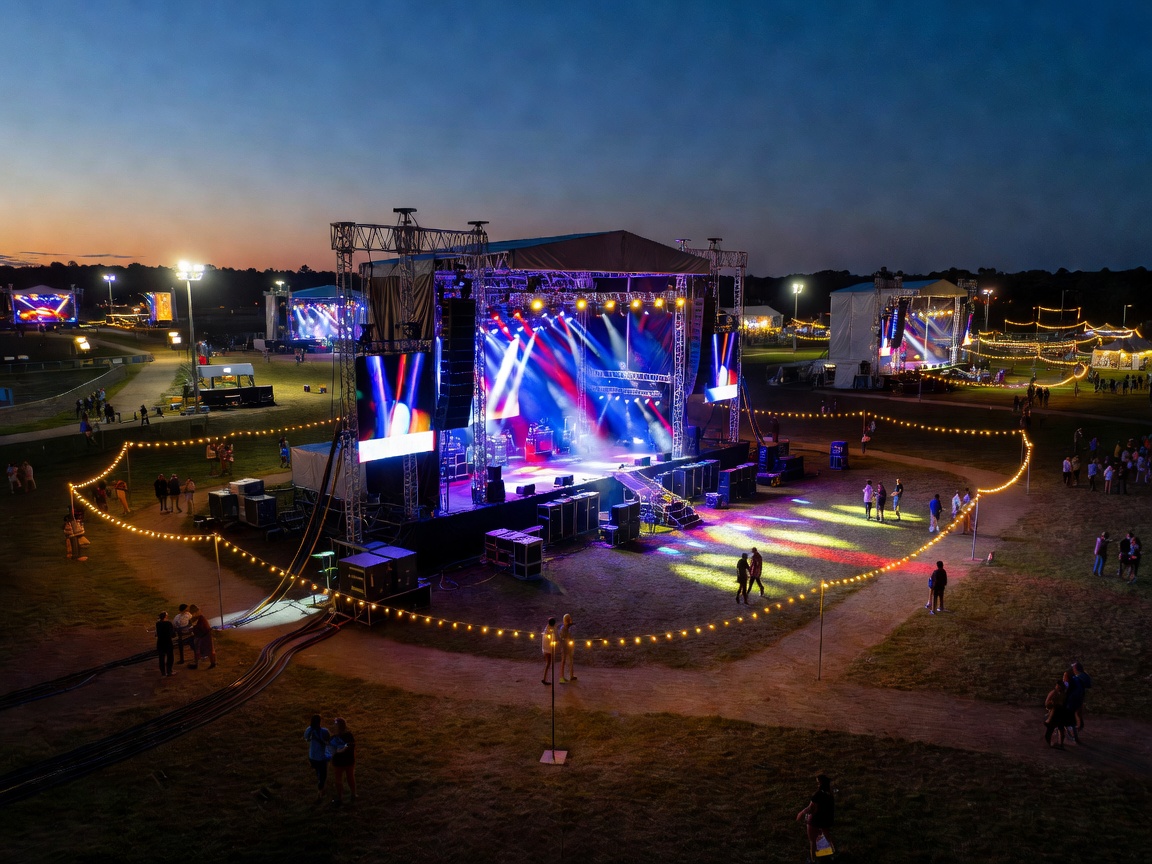
Illuminated main stage and hospitality walkways at dusk illustrating simultaneous evening festival electrical demand
Dusk represents a critical demand inflection point as perimeter safety towers, catering kitchens, and main-stage lighting converge.

From Speculative Requests to Metered Evidence

Modern festival sustainability programs treat demand reduction as the cheapest and cleanest form of electrical engineering. Replacing legacy tungsten stage wash fixtures and halogen site floodlights with high-efficiency LED arrays dramatically trims peak draw. Likewise, separating catering kitchens that cook with certified liquefied gas or induction hubs onto planned feeder schedules prevents sudden uncoordinated overload in food villages.

At off-grid events such as Portugal's Boom Festival or parkland gatherings like Finland's Ruisrock, pre-event vendor audits verify actual appliance lists before sockets are allocated. When traders plug in unlisted domestic kettles or portable fan heaters during a cold evening rainstorm, unbudgeted resistive load can trip sub-distribution breakers across an entire concession block. Documenting appliance inventories and installing zone-level metering transforms power planning from an administrative form into an iterative engineering record.

Qualification Reminder: Selecting specific transformer ratings, breaker curves, or conductor cross-sections based on load data is a regulated engineering task governed by standards such as BS 7671, SFS 6000, or NEC Article 525 and must always be performed by licensed electrical engineers.