Guide 02 · Distribution Architecture

From Source to Point of Use

Between a fenced supply compound and a stage monitor rack lies a structured cascade of switchgear, trunk feeders, protected crossings, and sub-distribution cabinets engineered to survive weather and crowd movement.

Tiered Architecture of a Temporary Grid

Large festivals rarely feed distant zones directly from a single generator using long chains of lightweight cords. Long unbuffered runs suffer voltage drop, create tangled fault paths, and complicate emergency isolation. Instead, temporary festival grids mirror permanent municipal networks in miniature, stepping power down through distinct, independently protected tiers.

At the origin sits the source compound. In urban venues such as Helsinki's Flow Festival (held at the historic Suvilahti power-plant district) or Oslo's Øyafestivalen in Tøyenparken, municipal medium-voltage or high-capacity low-voltage substations supply the bulk of site energy, dramatically reducing local exhaust and engine noise. On rural greenfield sites where permanent utility feeders are distant or undersized, acoustic generator farms operating under ISO 8528 and EU Stage V emissions rules—increasingly fuelled by hydrotreated vegetable oil (HVO) and paired with battery banks—serve as local power stations.

On very expansive sites spanning several kilometres, licensed utility contractors may even deploy temporary high-voltage ring mains linking mobile package substations close to major stages. Bringing higher-voltage supply closer to load centres minimizes copper cable bulk and voltage loss across open fields before stepping down to low-voltage distribution boards.
TIER 1 · SOURCE COMPOUND Grid Substation or Synchronised Generation / BESS TIER 2 · PRIMARY FEEDER CORRIDORS Protected Trunk Lines & Main Switchgear TIER 3 · ZONE DISTRIBUTION BOARDS Stage, Hospitality, Site Lighting & Camp Sub-Panels TIER 4 · POINT-OF-USE HANDOVER IEC 60309 Outlets & Residual-Current Protection

Each tier introduces physical separation and selective fault isolation so a local trip does not black out an entire site quadrant.

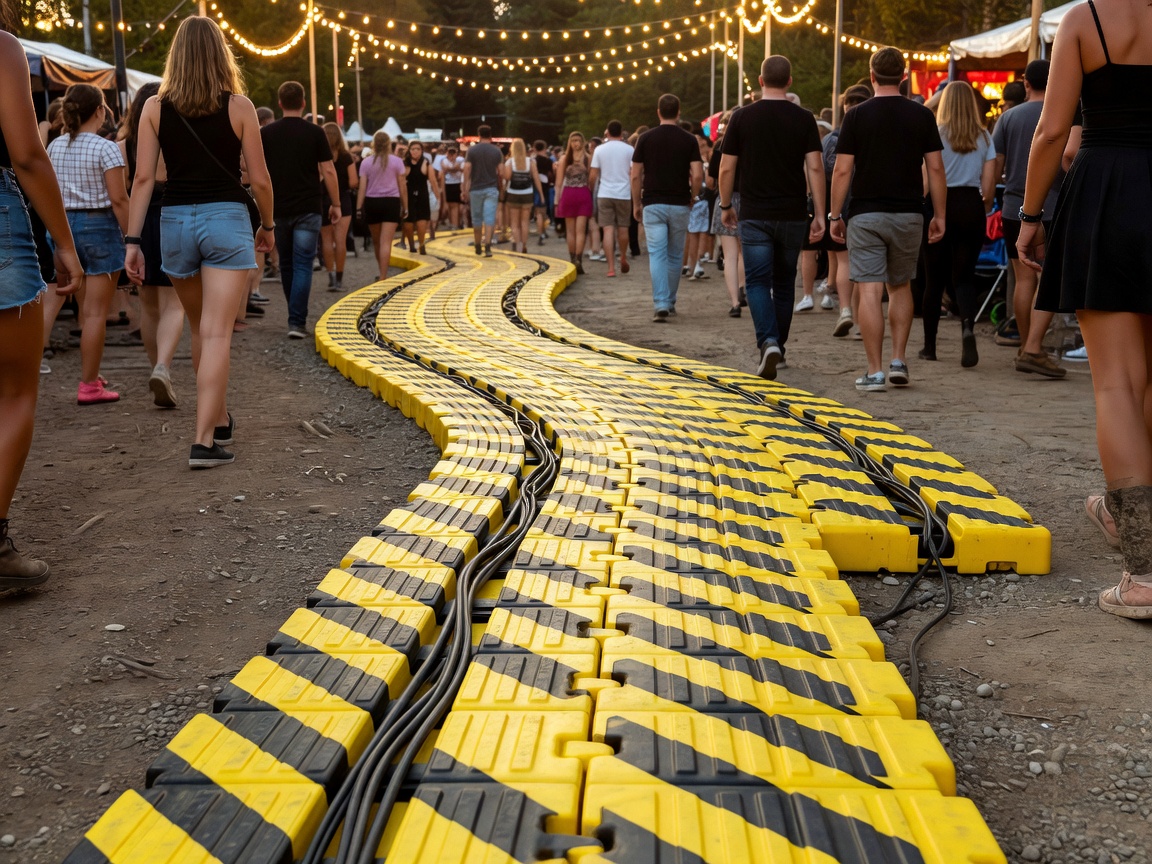
High-visibility modular cable ramps protecting temporary power feeders across a festival crowd walkway
Where cables must cross public circulation or emergency vehicle lanes, engineered ramps or overhead gantries preserve mechanical integrity and accessibility.

Physical Site Routing

Protecting Corridors from Crowds and Weather

Temporary cabling faces hazards rarely encountered inside walls: forklift axles, heavy rain pooling in low-lying grass, tent stakes driven without utility maps, and tens of thousands of festivalgoers crossing paths in darkness. Planning cable routing is therefore as much a civil site-management discipline as an electrical one.

Wherever possible, primary feeders follow dedicated back-of-house service corridors bounded by fencing so public foot traffic never contacts high-current conductors. When a crossing cannot be avoided—such as linking front-of-house sound desks to a main stage—sites choose between shallow protected trenches during pre-build, overhead truss portals clear of emergency fire-engine height limits, or interlocking heavy-duty cable ramps designed for wheelchair accessibility and heavy axle loads.

Connectors and distribution enclosures positioned outdoors rely on verified ingress protection ratings defined under EN 60529 (IP codes) to resist dust and driving rain. Raising distribution cabinets onto insulated platforms or pallets keeps sockets above standing rainwater and mud while allowing rapid visual inspection by electrical stewards.

Standards & Protection Concepts

Earthing, Selectivity, and Standardized Connectors

Connector Architecture

High-current primary trunks between generators and major switchgear commonly employ keyed, colour-coded single-pole connectors (widely known as Powerlock architecture) to prevent accidental phase transposition. At regional sub-distribution and point-of-use tiers, industrial pin-and-sleeve outlets standardized under IEC 60309 provide weather-sealed, mechanically robust interfaces suited to outdoor rigging.

Crucially, connector compatibility does not replace electrical verification. Only authorized electrical crews engage or disconnect high-current feeder interlocks under controlled isolation procedures.

Earthing & Fault Selectivity

Temporary installations governed by IEC 60364-7-740, DIN VDE 0100-740, and BS 7909 place strict emphasis on earthing arrangements, equipotential bonding of metallic stage structures, and residual-current protection. Because damp earth and exposed steel rigging elevate shock risk outdoors, rapid automatic disconnection of faulty circuits is non-negotiable.

Equally important is selectivity (also termed discrimination): coordinating upstream and downstream protective devices so an appliance fault inside a single food tent clears only that local outlet rather than dropping the primary stage feeder.

Reference Standard Jurisdiction / Body Scope in Temporary Festival Power
IEC 60364-7-740 International Electrotechnical Commission Requirements for temporary electrical installations at fairgrounds, amusement parks, and outdoor events.
BS 7909 British Standards Institution Management, organizational roles, testing, and sign-off for temporary entertainment electrical systems.
SFS 6000 SESKO / Finland Finnish low-voltage electrical installation standard including special outdoor and temporary event sections.
IEC 60309 International Electrotechnical Commission Standardized industrial plugs, socket-outlets, and couplers used across temporary distribution cabinets.
EN 60529 CENELEC Degrees of protection provided by enclosures (IP ratings) against solid objects and moisture ingress.
Safety Boundary: Earthing system design, earth-electrode testing, and protective device coordination require specialized instruments and formal authorization under national electrical safety laws (such as Tukes oversight in Finland). This overview is strictly conceptual.